
24 July 2026
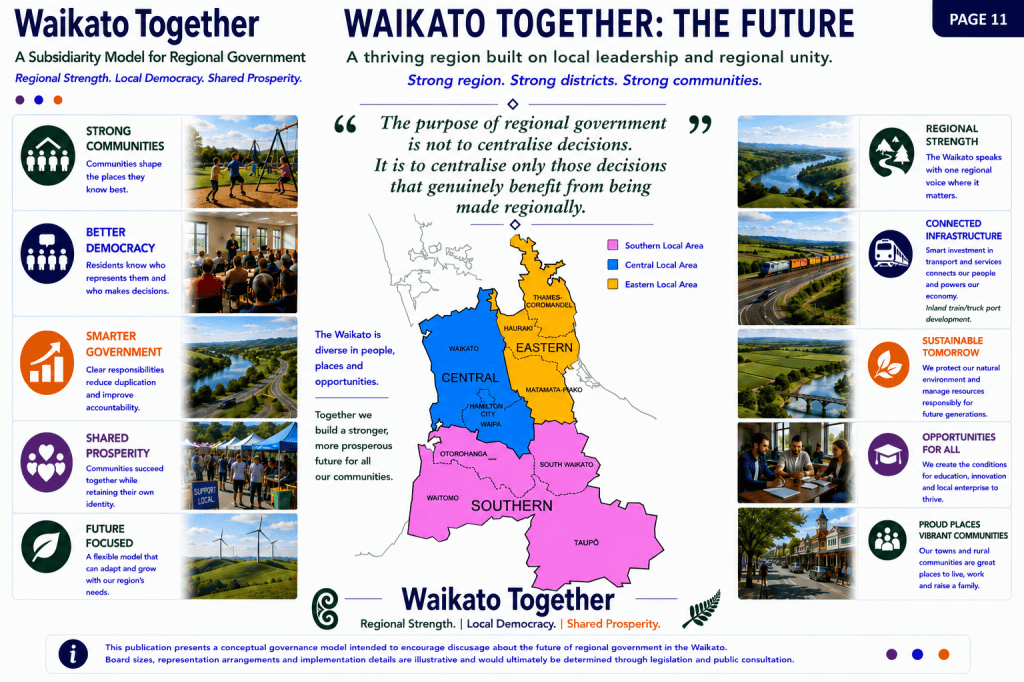
Over the past few months New Zealand has found itself discussing the biggest changes to local government since the Auckland reforms in 2010, and before that the nationwide reforms of 1989. To date most of the debate has been about boundaries and who merges with whom, but I think that’s the wrong question. Before we decide who should govern together, we should decide how regional government ought to work.
That’s what Waikato Together is about, and it’s the rules of the game which matter most not the players. The traditional model of Councils is that the smaller fish are inevitably the losers, and that bigger is invariably only better for the largest town or city centres. We don’t want that. The basis of Waikato Together is subsidiarity, which sounds like a complicated word but it’s actually very simple. It means that decisions get made at the lowest rung as possible, by the people who have to live with the consequences.
Watch the ten minute presentation below to find out more, and for the slides see HERE


Duncan – and where will be the cost savings? There will be more elected councilors, more admin staff who will control the whole operation for their benefit and little for the ratepayers.
The current issues we have in Taupo whereby the staff dictate everything to the councilors and subsequently to the ratepayers will only be magnified creating a large bureaucracy at the ratepayers cost.
Under the current situation we ratepayers have very little say – and the elected councilors also get very little decision making – just rubber stampers. And your proposal will make it worse.
Stay with the fallback position would be my view.
Rgds
Gerry Williams
LikeLike
The problem is the model, and as I state in the presentation it is the rules which matter more than the players. Yes I agree that magnifying the current Taupo District Council to just bigger would only magnify the dysfunction. That is why we need to rebuild it from the ground up as I describe, not from top down. But the benefits of bigger are access to more highly qualified professional staff and greater influence to Wellington, and these are not to be sneezed at. At the end of the day if it all costs ratepayers more than will be a fail and the Auckland model is not the best example of that, but they offer some valuable lessons to be learned from.
LikeLike