(Updated October 2026)
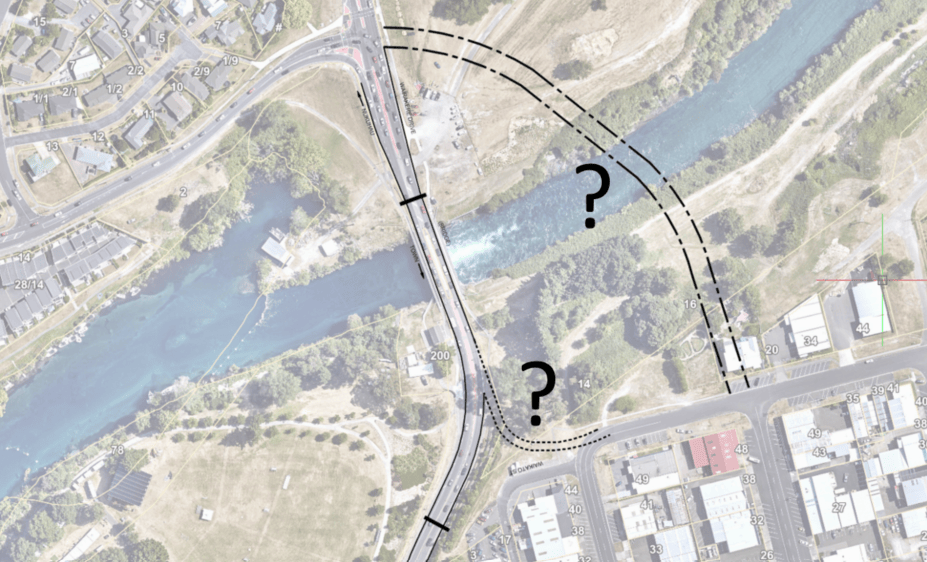
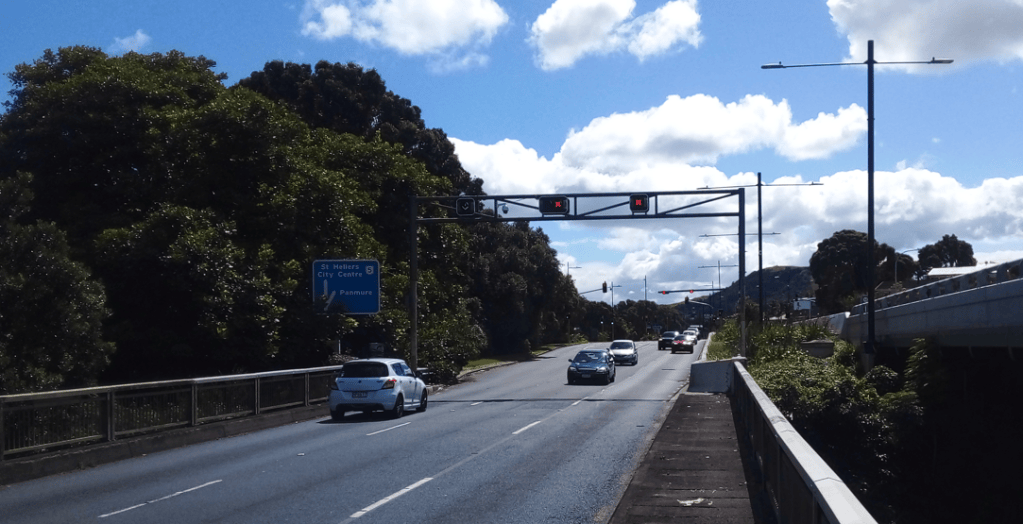
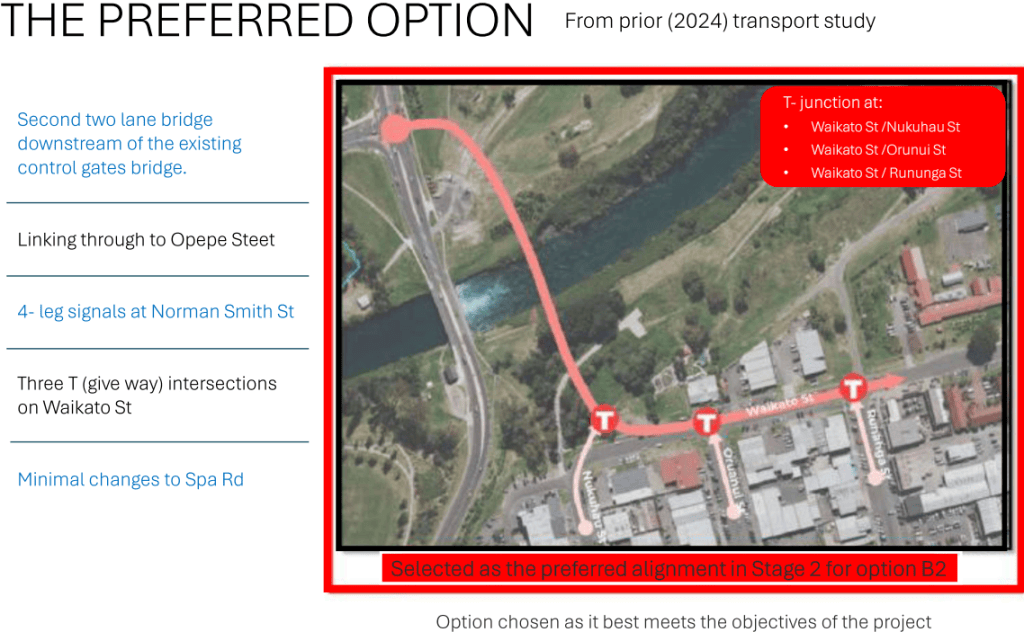
The Northern Access Transport Study was undertaken by a consultant in 2023/24 by Taupo District Council at a cost of some $300K. This was instigated by Mercury Energy who own the bridge, indicating that they wish to replace/relocate the Control Gates (currently in the centre of the structure) and hand over the bridge structure to Taupo District Council most likely within ten years. A new second bridge over the Waikato Bridge was touted as a key infrastructure requirement, and along with road connections comes to around $80M which was slotted into the 2024-2034 Long Term Plan (LTP). However, although this consultant study evaluated some of the consequences if we do not build another bridge at all, it did not properly consider a three-lane arrangement for the current bridge like the one in Pakuranga, Auckland shown right (and our bridge is a metre wider), nor did it consider a direct connection to Waikato Street from the existing bridge south side. By the way unlike water services, transportation is not legislated with any minimum levels of service for driver delay – so even though the residents on the north side of the bridge may not like it, Council could choose to never make any improvements at all. I am not saying we should do nothing, but we are at least owed a look at the options. That has not yet happened, but Council is still proceeding this 2026/27 financial year to engage a consultant for around $150K the next few years to carry on the design work as if we had.
Before we get to my suggested way forward, lets look at the timeline from 2023 onwards:
Aug 2023: Tender for the study was issued. I attempted to delay this happening until more proper consideration of its objectives, and despite my extensive experience and previously stated interest, was sidelined on the stated basis that “governance should not be interfering with operational matters”.
Feb 2024: Steering group appointed by Mayor Trewavas which comprised of Deputy Mayor Taylor and Councillors Loughlin and Williamson. Although I was not included, there was an expectation that this steering group would be reporting back to full Council before any major decisions get made – but this did not happen.
May 2024: The Draft LTP was signed off by elected members which included the recommendations of this study for an $80m solution. I declined to sign, partly because of the lack of information surrounding this study (watch a snippet of that discussion HERE). I soon after discover that a draft copy of the study had been circulated to the steering group and Council staff several weeks beforehand, but never shared with other Elected Members.

July 2024: I submit a Notice of Motion to force that a workshop for elected members be made to happen, and this was passed by majority decision which you can watch HERE (first item on the agenda, immediately following some unpleasantries where I attempted to declare my own absence of Conflict of Interest despite recent media coverage of Mayor Trewavas strongly implying that was the case). I attempted to secure a date as soon as possible, but this workshop was subsequently pushed out to May 2025 some 10 months afterwards. I also refuse to sign off on the final version of the LTP, mainly because of the lack of transparency surrounding this and some other projects.
May 2025: Workshop of elected members was held on 22 May 2025, which you can watch HERE to see if you concur with my summary of it as gaslit gala of the smokin’ mirrors.
July 2025: Shareable copies of these consultant reports were finally released to myself, over a year after I first started asking, and anyone interested can read them here: Part 1; Part 2; Part 3; and Part 4. In addition, here are some notes on this subject which I have been penning in this topic since September 2022.
September 2026: We had a workshop as part of the upcoming LTP which included a large segment for the bridge which you can watch HERE. I gave my own writeup about it which you can read HERE, where no opportunity was given for me to present my own summary of events or alternative way forward.
So apart from a staff workshop presentation in 2025 nearly a year after the study was complete, and a follow up workshop in September 2026 – Elected Members at Taupo District Council for this $80M project have never been presented with any options or ever had any sort of debate. My own interest in this is fairly self-evident – I am a traffic engineer by profession for the past 30 years and this is definitely my field (I am the most qualified in the district as far as I know).
This isn’t about opposing a second bridge, because nobody doubts it would be a nice thing to have. It’s about opposing a process that decides first and justifies later, and I think Taupo deserves better than machiavellian committee stacking, withheld reports, and the illusion of participation. Apart from that, I know from experience that having a client which knows much less than the consultant yet specifying what their work will entail is a fraught exercise at best. We have to date spent around $300K on a consultant to basically tell us what we expected to hear (i.e. that we need a second bridge), and before we spend the budgeted $150K for them to carry on their work, I say this topic needs to be properly revisited and subject to debate and voting.
So how could it work then, if we don’t do a second bridge?
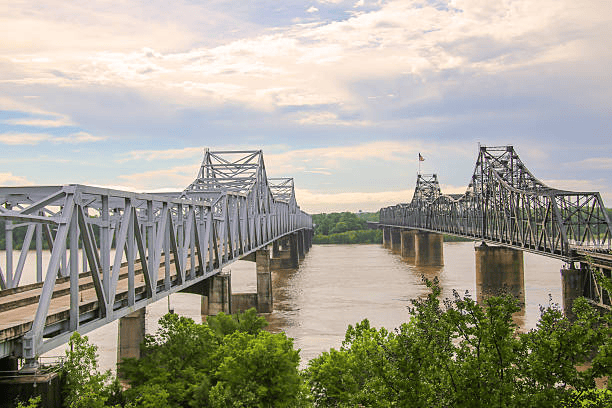
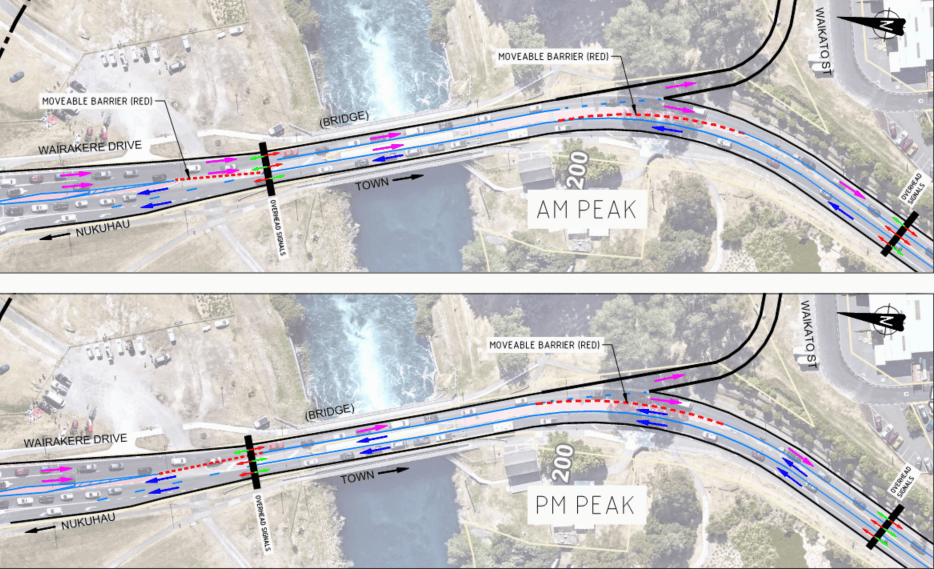
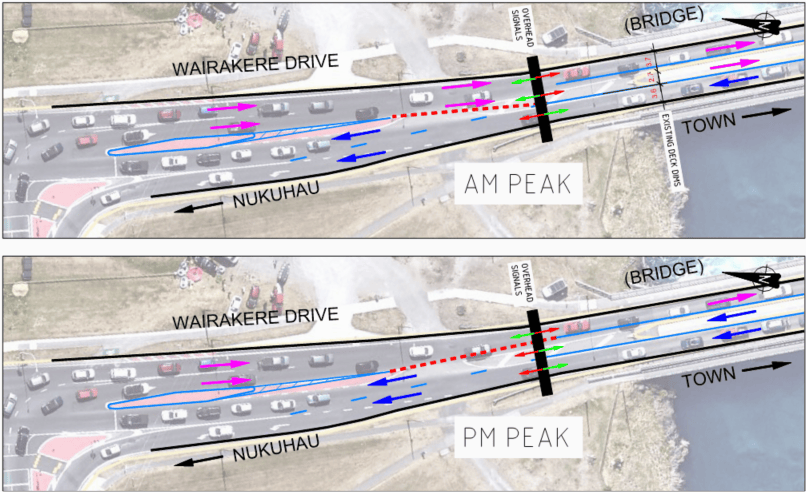
My own suggestion is to consider a dynamic three-lane arrangement for the existing bridge (at 10m the bridge deck is wide enough) along with a direct connection to Waikato Street, refer pictures at the bottom of this page. I believe that this could be a good enough long-term solution for Taupō and that no second bridge will actually be necessary. As at May 2024 there had been no assessment of the existing Waikato bridge structure to determine when it needs refurbishing or replacing, and in a recent workshop in September 2026 we were informed by staff that it could have another 40 years life – but until I see the evidence myself, I am not convinced that Taupo isn’t in for two new bridges to build and maintain not just one!
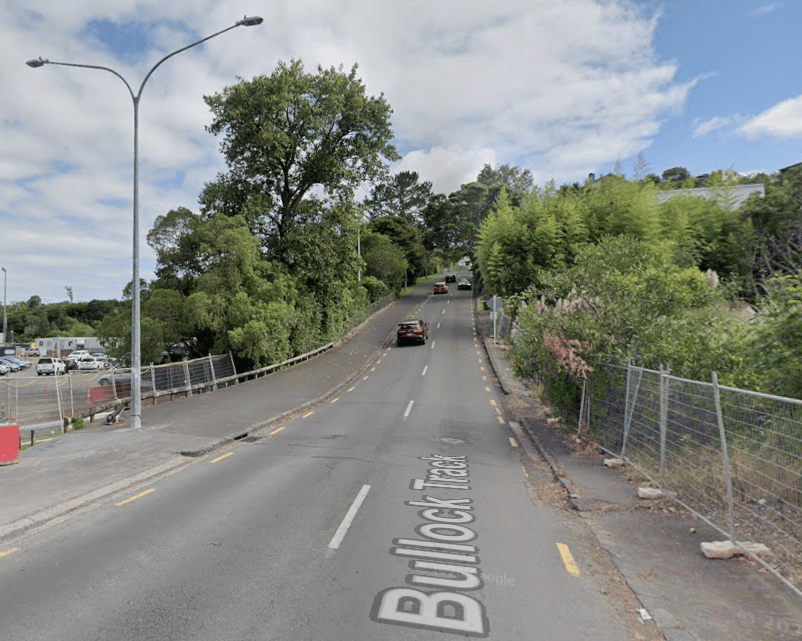
With respect to a direct road connection between the existing bridge and Waikato Street, steep gradients are not unprecedented and similar examples are Ayr St in Parnell and Bullock track in Grey Lynn at around 16% which have no heavy vehicle restrictions. So to disregard that option on the basis of gradient just because it doesn’t meet any guideline ideal, I think is quite shortsighted if we can save the cost of a new bridge. Perhaps the consultant we engaged didn’t think of it at the time I simply don’t know, but in the September workshop they acknowledged it as a potential option.
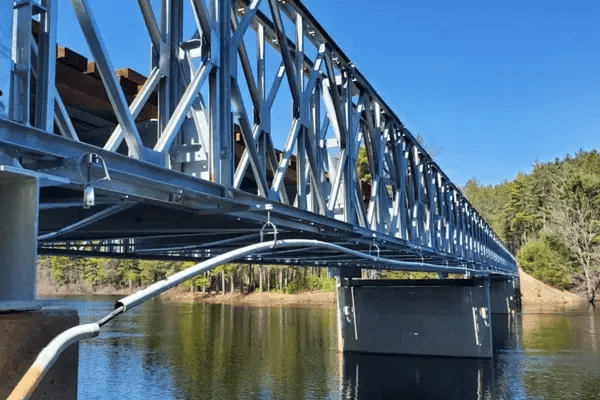
Resilience has also been mentioned in passing e.g. what if the one bridge fails in an earthquake? The closest alternative route involves around a 12 km diversion (coming from Nukuhau) which is not unthinkable for a temporary situation, and Bailey Bridges could most likely be implemented by the army in a matter of weeks if necessary (we are only talking a 50m span). We aren’t Gisborne or the West Coast which if some of their road connections fail are in real dire straights.
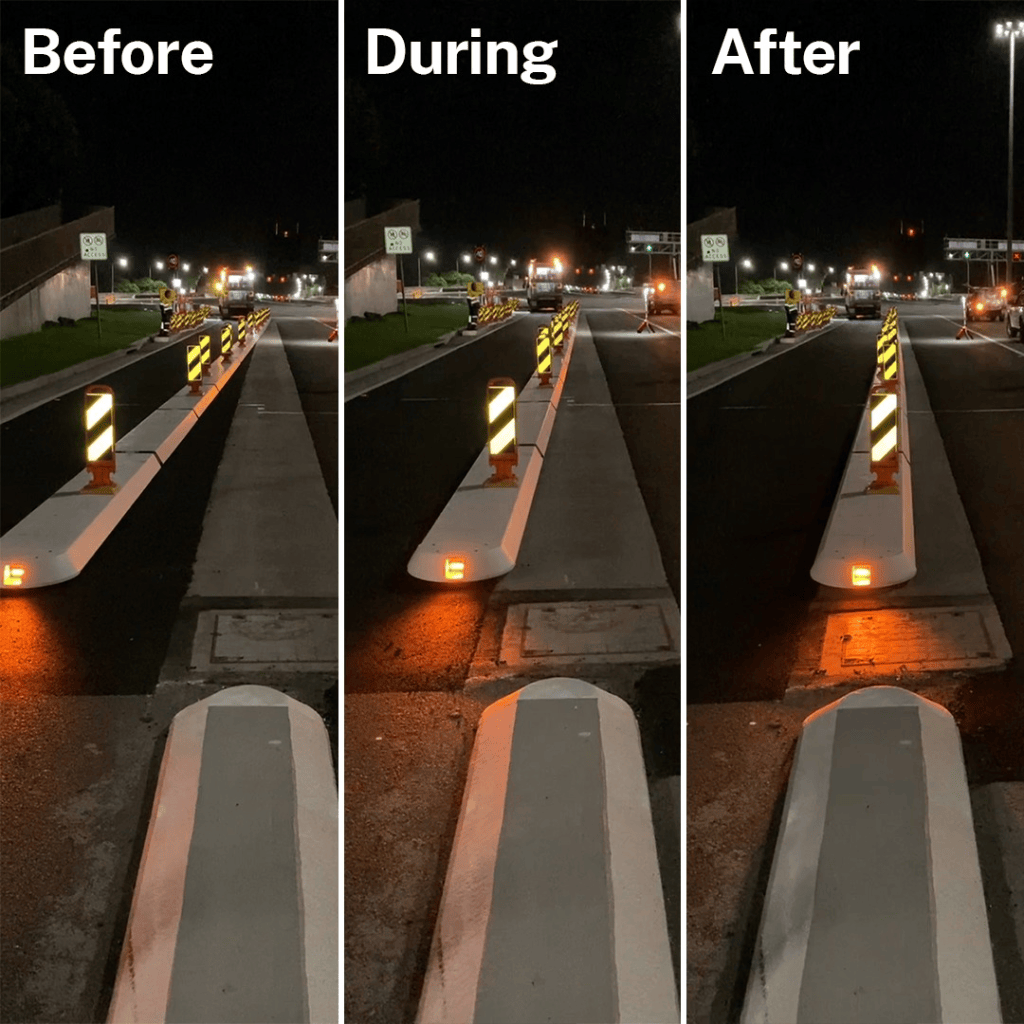
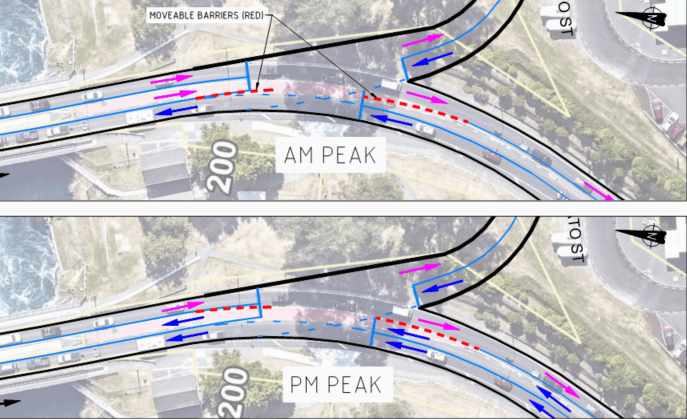
With regard to dynamic lanes, there are at least two examples in Auckland: Panmure and Whangaparaoa. Overhead signals are just one mechanism to clarify correct lane use, also LED road stud markings and in Sydney they use electronically moveable medians as shown right.
People of Taupo, we can do much, much better than this. Do you really want to pay for something which we don’t even really need?
My sketches are below which should be fairly self-explanatory, and at bottom we have a two-way Waikato Street connection with signals option to assist the evening peak. My aim is to get this tabled for proper consideration in the near future, which should have happened in 2024 but childish politics got in the way. Because we probably won’t be otherwise seeing any improvements for perhaps decades, and this could fix for a fraction of the price.
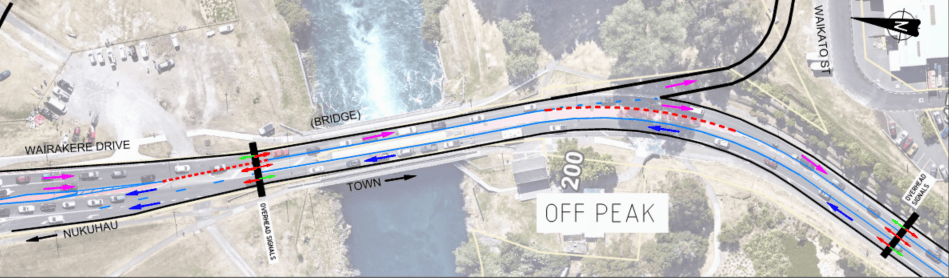
Option for a two-way Waikato Street connection: