
29 July 2025

This Thursday 31 July, Taupō District Council will vote on whether to adopt the new Joint Management Agreement (JMA) with the Tūwharetoa Māori Trust Board (TMTB). The full agenda is available here
Despite growing public concern, the staff recommendation remains to adopt the agreement in full. A fourth option – deferring the decision until after the election – has now been added, but without any commitment to public consultation or independent legal review. I say that’s not a compromise, it’s kicking the can without accountability.
The JMA embeds significant co-governance over planning, consenting, and environmental functions—many of which directly intersect with the Resource Management Act (RMA). Yet just two weeks ago, the Government froze RMA plan changes due to legal instability. Council’s own policy paper (Attachment 4) makes no mention of this. Instead, it repeats that the JMA is ‘not significant’ enough to require public consultation.
It also claims that co-governance concerns are irrelevant, calling this ‘co-management’ instead. Whether that distinction holds water legally is questionable – but politically, omitting national legislative context and public concern is indefensible.
Council staff offer no updated legal analysis, no plain-English summary, and no consultation plan. The public is still being sidelined. And the public deserves legal clarity that isn’t filtered by politics or internal convenience – if this agreement is so robust, let it stand up to independent scrutiny.
I’ve also raised potential conflicts of interest involving two elected members with close family or governance ties to TMTB. The CEO’s response: ‘Up to each councillor‘ – technically accurate, but politically negligent – and potentially damaging in the event of judicial review.
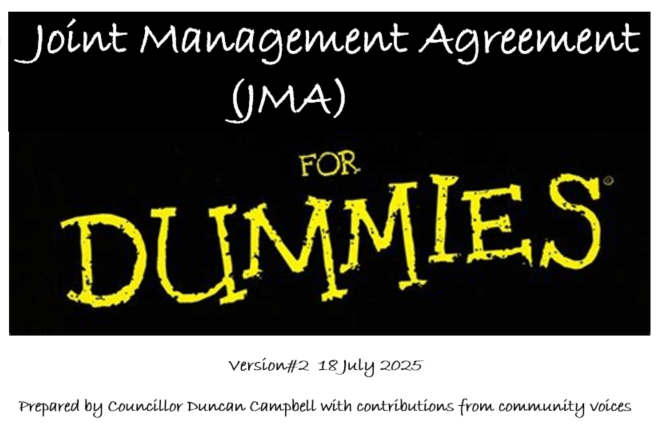
Meanwhile, staff say public feedback was ‘factually incorrect’ – referring to a Hobson’s Pledge newsletter – but offer no evidence. The referenced Attachment 5 isn’t a rebuttal, it’s an AI-generated summary that largely validates public concerns: lack of consultation, unclear governance shifts, and democratic erosion. If misinformation is being alleged, specifics so matter. Because without them, these claims look less like correction – and more like deflection. Also of note is that I circulated my JMA for Dummies to all councillors and senior staff explicitly asking for corrections – none were received.
This isn’t about obstruction – it’s about integrity, scrutiny, and public confidence. Council can and should pause this process, but only if it commits to doing the next part properly: with transparency, legal independence, and plain-English public consultation. Because anything less won’t just disappoint – it will fail the test of democracy.
And sometimes, good intentions just aren’t enough.







 duncandoestaupo.com