
24 June 2025
This is a transcript of my presentation in Council Chambers on 24 June 2025 during deliberations for the Local Waters Done Well decision which was disallowed to be aired.
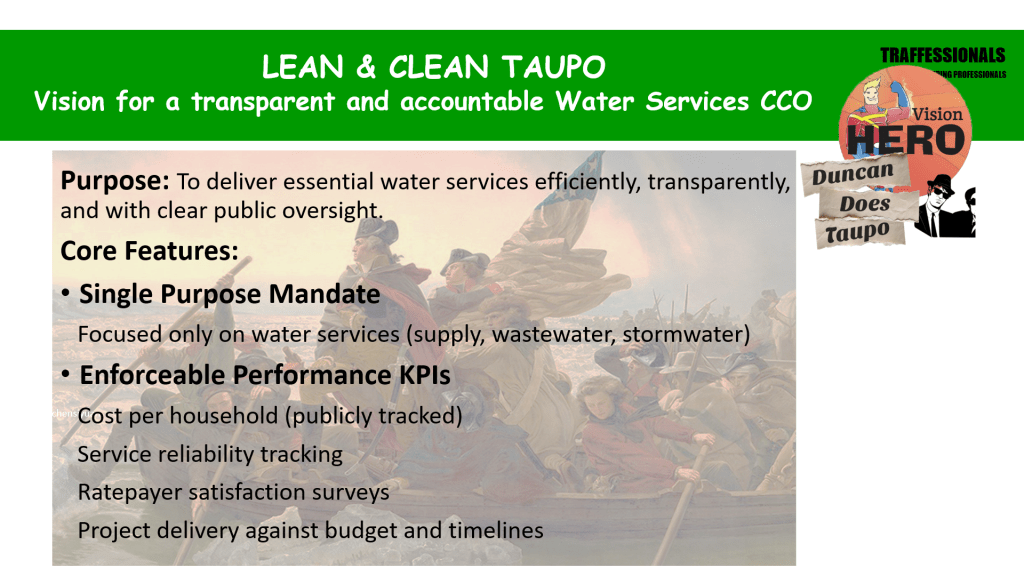
Mr. Chair, colleagues—The decision day for this has been pushed to July 29 – I see that delay not as a setback, but as a window. A chance to breathe, to reflect, and to challenge whether we’re truly on the best path. So I’ve assembled a brief outline of what an accountable Council Controlled Organisation (CCO) could look like—what I’m calling Lean & Clean Taupō.
Why now, you might ask? Because despite months of workshops, the flow of material has not allowed for real scrutiny. No PDFs for us to share for independent third party advice, and no analysis we could test. The most consequential restructure in decades—yet councillors and the public alike have been kept in the fog. And that fog is not new. I no longer believe in ‘local control’—not in this district. What we call ‘Council-led’ is in reality staff-led. We are routinely presented with decisions pre-deliberated, framed to funnel consensus agreement, and starved of comparative data. That’s is not my definition of responsible governance, that is an exercise of ritual rubber-stamping. So until Council control means genuine accountability, I cannot endorse the staff paper preferred Option 1 for an Enhanced Inhouse Business Unit , which I now see quite clearly as a maintenance plan for continued dysfunction and an institutionalized powerlessness to elected members.
Now, the Option Summary presented to ourselves and the public as evidence? It’s a glossy conclusion sheet, unsupported by method or peer review. Differences in projected costs between options are marginal— and well within margins of error. No costed comparison of councils that adopted full CCOs. No performance benchmarking, and no taking account any efficiency gains of a more focused governance model. What’s seemingly been dismissed as ‘too complex’—Option 3 for a CCO— I now see as the only model which invites more scrutiny than evading it. The Department of Internal affairs has already flagged we have expensive operating costs – and they should know – and I have no doubt this will continue unabated if the preferred Option 1 comes to pass.
In this context, I see a carefully designed CCO—tightly governed, transparently run—as potentially offering more real-world accountability than the other options.
So what do I mean by “carefully designed”, and which we don’t have now, and in which the other Options might be deficient?
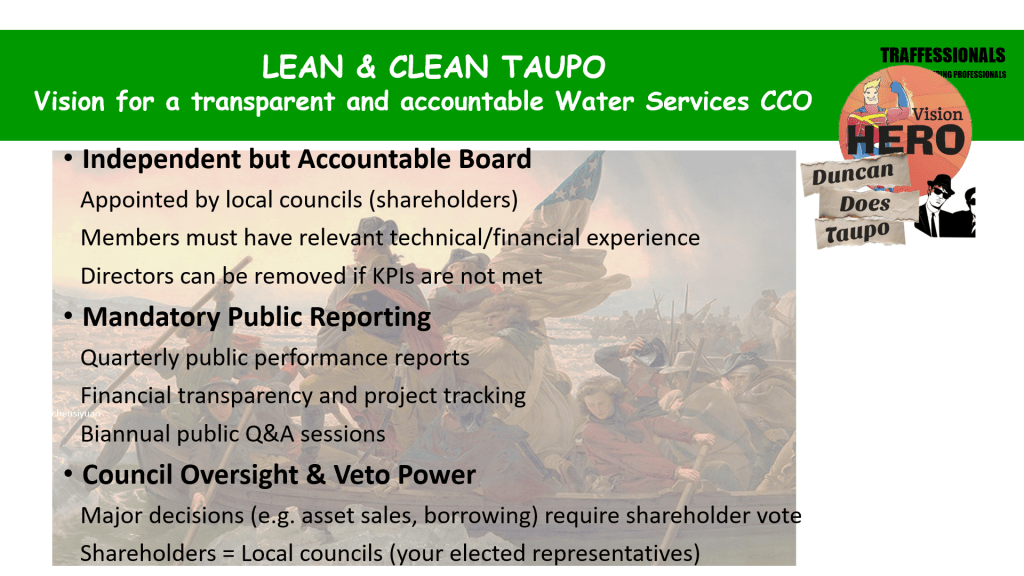
- A single purpose: water only, with no mission creep.
- Enforceable KPIs: cost per connection, reliability and user satisfaction.
- An appointed board of well qualified individuals technical and financial
- Mandatory reports publicly, not just internally.
- Council as shareholders retain veto power over major decisions.
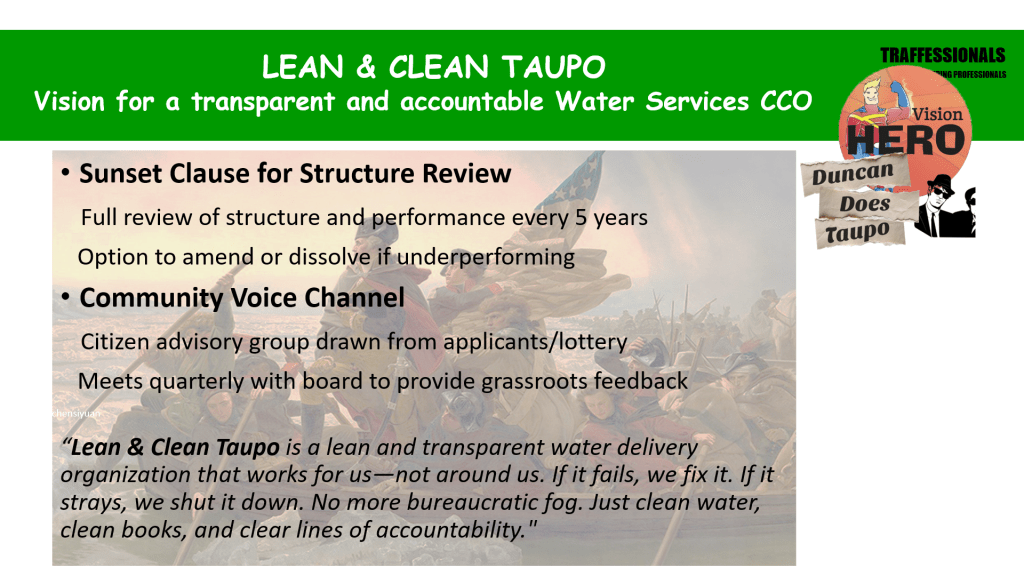
- A sunset clause: 5-yearly full review to test performance and address deficiencies.
- Not least, a channel for community grassroots feedback
There is no such thing as a utopia this side of heaven, and I recognise it would take some time to set up right. But I believe for us, a CCO represents a governance with consequences, the kind of which we are otherwise simply not going to get. I think if we had a CCO in place now, maybe we wouldn’t be greenlighting $20M wastewater projects for Turangi that aren’t even environmentally necessary, or at very least we would have to be more transparent about it. And maybe, just maybe, our ratepayers would have more faith in us, and maybe our future elected members will have real levers to influence and not just ceremonial seats of tickboxing.
Otherwise, I just see us institutionalizing a system that is not serving democracy now, and is costing more than it should.
 duncandoestaupo.com