
The following are four articles which I put out between January to April of 2024, intended as a gateway introduction to how Taupo District Council operates. Although some of the referred issues might not be currently relevant, I hope it can still be useful.
Councillor Chat Part 1: Welcome to the Machine 8 Jan 2024
Taupo ward Councillor Duncan reporting, and this month I want to pen a few thoughts as a first time local politician. Writing can clarify my thinking, and your feedback helps too. It may also be of possible benefit to anyone with a sense of civic duty who might aspire to get on the campaign trail themselves – but be warned: if you didn’t like High School, then you probably won’t much like the atmosphere of local politics either.
Elected Members as myself do have some influence on how Council functions, but in practical terms this can depend upon the degree of influence to the other Elected Members. Basically if I want to change anything in the way the CEO does Council business, I need to convince the majority of Elected Members to agree, or 75% in order to reverse any previous decisions. So if the makeup of Elected Members is already of a certain mindset and way of doing things, you can appreciate that substantial change of direction will not be an easy thing coming. One significant difference to a regular job though (and we do get a base salary of about $39K), is that Elected Members only get fired by The Boss every three years when local body elections come around. So in theory at least, we have a fair bit of room to speak freely.
Upholding the reputation of Council is upheld as a clear priority if not explicitly stated, and with that in mind, Elected Members are sometimes only given information if and when at the discretion of the CEO with background support of the Mayor. In practice this can mean that we are sometimes not much better informed than the average ratepayer about important or sensitive issues. In addition, Council is not always a place of vigorous intellectual debate where the aim is to get to the bottom of things.
Some words of a seasoned local politician I talked to from another region, I can’t say do not ring some bells every now and then:
‘Elected representatives nowadays have been ‘housetrained’ to focus on what management (i.e. the CEO & executive staff) prefers them to focus on. You are not only dealing with undemocratic managers but I imagine a claque of house-trained councillors who can be counted on to act as yapping guard dogs for management who no doubt are subservient to what XXXX wants them to do. Do not let them prevent you doing the job you were elected to do.’
And on that note, I will sign off for today.
Councillor Chat Part 2: Code of Conduct Confessions 24 Jan 2024
Taupo ward Councillor Duncan reporting on Part 2 of my Councillor Chat series about workings of The (Council) Machine, as I see it anyway.
Code of Conduct (COC) – what is it anyway?
COC is a set of rules of behaviour which local politicians sign up to abide by, and is obstensibly there to maintain the effectiveness and credibility of Local Government. It includes things like not sharing confidential information, and restrains Elected Members from doing things such as publicly criticising Council staff or fellow Councillors. This all sounds reasonable enough, but in my brief time as a local politician I perceive that it can be leaned on in ways perhaps unintended. In other words, I don’t blame the toolbox so much as those who sometimes wield it.
Thus far I have faced several warning notices of COC infractions by our Mayor in the course of my now 15 month stint, briefly summarised below:
Building Fraud Case
Although half of Taupo seemed to already know the goings on before Councillors were ever formally informed in a confidential meeting in June 2023 (I had previously overheard it being talked about at my son’s soccer game), I was castigated at the Council table for subsequently making my own enquires with Engineering NZ, which is the professional body that I belong to as a Chartered Professional Engineer. I was making some enquiries because I had a sense that, given Council is the Building Consent Authority which gave the final tick off on the basis of hundreds of apparently fraudulent Producer Statements (which by the way, have no legal standing) – perhaps Council might bear some portion of responsibility. However, The Machine was so unimpressed with this alleged breach of confidentiality that it immediately forked out $4K for a 90 minute private interview with a (nice enough) lawyer, who proceeded to educate me on how to be a ‘good’, or ‘useful’ Councillor, but was not prepared to adjudicate if I had even done anything wrong (which I firmly maintained that I had not, because no identities were ever disclosed). I was also directed in future matters of confidence, to only ever go through our CEO if I wish to undertake any due diligence with third parties, including my own professional body. Because I never did recant, this incident is still inferred at the Council table as a demonstrated lack of integrity, and another reason to be wary of sharing too much information with Councillor Duncan.
Criticising Staff or Councillors
I have lost count of how many times the Mayor has felt the need to issue warning notices to me in this area, and I do acknowledge it is a tricky area for me to negotiate. Being a qualified person in a trade where straight-talking is valued, and in a town where (in my humble opinion) my own particular field of expertise is not taken seriously enough (i.e. transportation) – probably does not help. And it is just not seen as cricket for an Elected Member to infer (even in closed meetings) that staff might be inexperienced, let alone incompetent or acting with undue bias. Criticising any past decisions made by sitting Elected Members is also seen as offside.
To Conclude
We are elected as a form of oversight of Council, and I believe to do this properly does in fact require some sort of critical evaluation in the way it operates, and this has to include going into detail from time to time. This can only mean direct questioning and the sometimes suggesting of uncomfortable truths, which is what I reckon we are put in there to do. However, this viewpoint is certainly not very widely shared by other Elected Members at Taupo District Council.
As an aside, one Elected Member even said to me that if a Council meeting held in confidence included a plate of biscuits – we were not to even disclose the fact we had any biscuits! I do not think they were joking.

Councillor Chat Part 3: Elected Members are in there to oversee Council… right? 21 Feb 2024
Taupo ward Councillor Duncan reporting on Part 3 of my Councillor Chat series about workings of The (Council) Machine, as I see it anyway.
Elected Councillors are in there to oversee Council… right?
Good question, and the answer may interest you. In the governance role we Elected Officials are responsible for approving policy documents, but as I see it are expected to show little interest in following up on the results. Instead we are only expected to take serious interest in issues when they are presented to us, by staff, at the Council table.
In the words of our esteemed Mayor, after I was asking some probing questions about something or other:
“When input from a governance perspective is required it will be brought to the table for the elected members to review and discuss. You are a councillor in a governance role, you are not management in an operational role. Please stop contacting staff members regarding these issues and let them get on with the exceptional work they do…”
My own interpretation of good governance is to take an active interest in things, and step in to ask the necessary questions when it is looking as if the outcome could be below par. I would love to kick back and pretend that things will work out fine, but I do not believe people voted us in for that, and my past experiences tell me that life is never that simple.

If you read my Councillor Chat Parts 1 & 2, you will realise that it is Council staff who are really running the show and not us Elected Members. Perhaps below will illustrate.
Northern Access Transport Study (for a 2025 update on this topic read here)
A Council tender for the Northern Access transport study was put out in August 2023, and this basically involves the evaluating of new road connections to the Taupo town centre, including future route options for the Control Gates Bridge across the Waikato River which is owned by Mercury Energy. In my experience, putting out a tender for something which the client (i.e. Council) does not have requisite experience can be a fraught exercise, and sometimes even be a complete waste of time. I do not know the contract value of this latest study, but expect it could well end up in the six figures. Does anyone remember the $140K transport study in 2018 which recommended all those traffic signals for Taupo town, and that locals rejected out of hand when consulted? I suspect one key lesson Council also took from that particular exercise, was that asking the public what they want can be counterproductive to achieving a desired outcome (Taupo Town Transformation Project, anybody??).
As an Elected Member and the most qualified person in transportation at Council (and in the district, as far as I am aware), I had expected to be conferred with beforehand. Because after all, this was a large reason for me getting elected, and conflict of interest is hardly a thing because I do virtually no work in the district. So given previous assurances by staff that my input was valued, I was quite taken aback when this did not happen. After the contract was awarded a few months later and despite my efforts to intervene for a rethink, our Mayor nominated a Steering Group committee for this Northern Access transport study which does not include Councillor Duncan aka the Traffic Engineer.
Some people say that living in this small town is all about who you know and not what you know. I really can’t imagine why, can you?
Councillor Chat Part 4: Local Government is Flawed 29 Apr 2024
Taupo ward Councillor Duncan reporting on Part 4 of my Councillor Chat series about workings of The (Council) Machine, as I see it anyway.
Local government is flawed
From Section 10 of the Local Government Act:
The purpose of local government is:
(a) to enable democratic local decision-making and action by, and on behalf of, communities;
(b) to promote the social, economic, environmental, and cultural well-being of communities in the present and for the future.
I say that part (b) is flawed, because it effectively gives licence for a Council to decide anything and everything, and all on the subjective interpretation of what is considered best for you or your descendants. I don’t think it will be hard to think of some local examples where significant things happened without your opportunity for input.
As for Taupo District Council, I perceive it is quite a grey area as to whether or not residents will be consulted on for any particular issue, except for a few items like the Long Term Plan or new bus shelters which are both obligatory by law. I believe that meaningful public engagement is often only done as a last resort, and only if it doesn’t jeopardise any status quos. Not helping things, I believe, is that some Elected Members consider themselves as being voted in as your direct representatives so therefore see little need to confer with residents except for once every three years.
My proposed solution, for starters anyway:
If any of you have ever read Isaac Asimov’s ‘Í, Robot’ series, you will be familiar with his influential Three Laws of Robotics in the picture below.
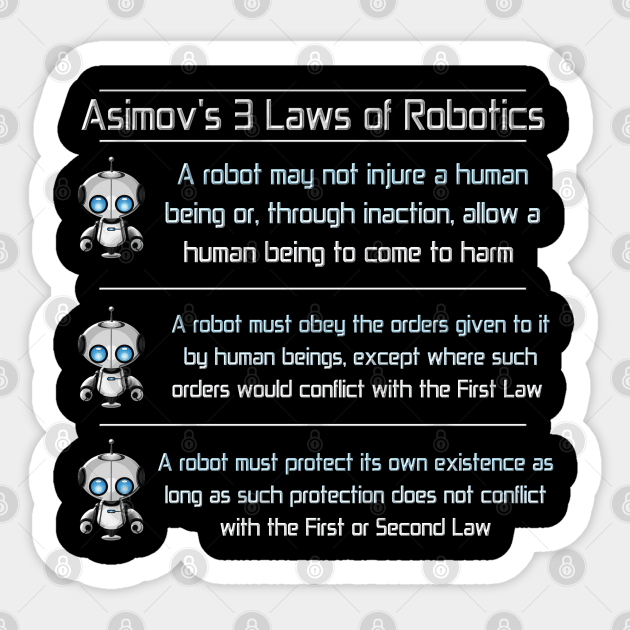
I reckon there is a good analogy with local government, so have added my own alterations in bold:
The purpose of local government is:
(a) to enable democratic local decision-making and action by, and on behalf of, communities;
(b) to promote the social, economic, environmental, and cultural well-being of communities in the present and for the future, except where such actions conflict with (a);
(c) to protect its own existence, except where it conflicts with (a) or (b)
I am not sure (c) is absolutely necessary, but given central governments propensity to eradicate local influence, it mightn’t be a bad thing to include.
What do you think?
To close off and as an aside, do you realise that the Councillor Korero media releases in the Taupo & Turangi Herald are quite stringently regulated? In these articles we are not permitted to make statements of a political nature or infer criticism of any Council policies, and my contribution last December was censored on these basis.

 duncandoestaupo.com